
PROFESSIONAL MANAGERS OF OTHER PEOPLE'S OPINIONS
Let's be serious.
Many of us don't live our lives.
We manage public perception.
We make decisions while imagining how people will react.
We choose careers partly because of the respect attached to their titles.
We buy things we don't particularly need because we want to appear successful.
We remain in relationships long after they've become unhealthy because we're afraid of what people will say.
We attend events we don't want to attend.
Agree with opinions we don't believe.
Laugh at jokes we don't find funny.
And sometimes, we even pretend to be happy because explaining our unhappiness would require conversations we're not prepared to have.
And the most ridiculous part?
The audience we're performing for is usually too busy worrying about its own reputation to pay as much attention to us as we imagine.
Think about that.
You're sacrificing your peace to impress someone who is also sacrificing their peace to impress somebody else.
An entire society of people pretending for the benefit of other people who are also pretending.
What a magnificent waste of human existence.
Braess's Paradox: Adding Roads Increases Traffic
Removing options and eliminating shortcuts speeds up the entire network.
THE TRAGEDY OF BEING LOVED FOR SOMEONE YOU'RE PRETENDING TO BE
Here's something that bothers me.
People say they want to be loved.
But what exactly do they want to be loved for?
Their actual personality?
Their genuine beliefs?
Their imperfections?
Or the carefully edited version of themselves they've spent years presenting?
Imagine spending twenty years becoming the person everyone expects.
You become the responsible child.
The agreeable friend.
The impressive professional.
The respectable member of society.
Everybody praises you.
Everybody says you're wonderful.
And somewhere inside, you're miserable.
Because all the admiration is directed towards a version of yourself you no longer recognise.
And perhaps this explains why external validation can become so addictive.
You get praised.
You feel good.
Then the feeling disappears.
So you need more praise.
More recognition.
More acceptance.
Another compliment.
Another achievement.
Another opportunity to prove that you deserve to be liked.
At what point does that end?
How many people must approve of your life before you finally grant yourself permission to live it?
The Quantum Zeno Effect: Freezing Reality Through Observation
Merely looking at something repeatedly literally prevents reality from changing.
THE SEPARATION OF TASKS: OTHER PEOPLE'S OPINIONS ARE NOT YOUR ASSIGNMENT
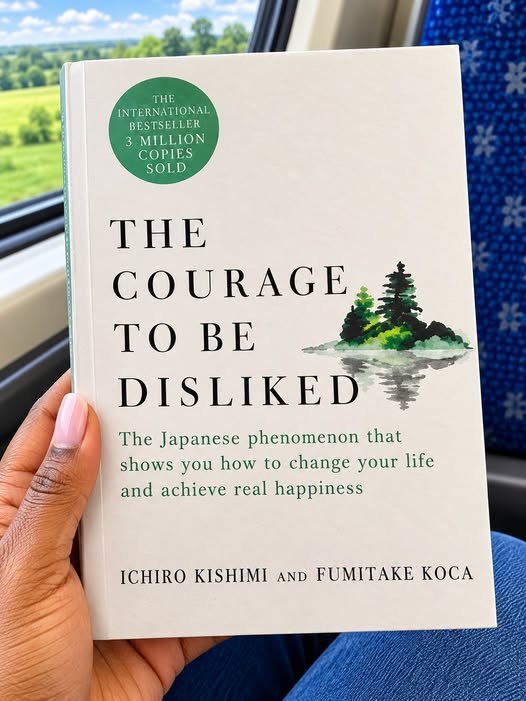
One of the most fascinating ideas in The Courage to Be Disliked is something called the separation of tasks.
The book introduces this through the philosophy of Alfred Adler.
The basic question is simple:
Whose responsibility is this?
Suppose I make a decision after honestly considering its consequences.
I explain myself respectfully.
I act with integrity.
And somebody decides they don't like me anymore.
What exactly am I supposed to do?
I can listen to their concerns.
I can reconsider my decision if they've identified something I've overlooked.
I can apologise if I've caused harm.
But can I force them to approve of me?
No.
Their judgement belongs to them.
My conduct belongs to me.
But this is where things become difficult.
Because many of us don't simply want to make good decisions.
We want everyone to agree that our decisions are good.
We want to say no without anybody becoming disappointed.
We want to establish boundaries without anyone calling us selfish.
We want to pursue unusual ambitions without anybody questioning our judgement.
We want to become independent without ever making our parents uncomfortable.
In other words, we don't just want freedom. We want freedom without the social consequences of exercising it.
And perhaps that is why so many people remain trapped.
They're waiting for a permission that may never come.
Alien Hand Syndrome: The Autonomous Rebel Limb
Part of your physical anatomy operates as an independent conscious agent actively sabotaging your commands.
A DANGEROUS MISUNDERSTANDING: BEING DISLIKED DOESN'T MAKE YOU RIGHT
This is where I refuse to turn the book into another collection of motivational nonsense.
Because I can already imagine someone reading it and announcing:
"I don't care what anybody thinks about me!"
Wonderful.
But what if you're actually a terrible person?
What if people dislike you because you're dishonest?
What if your colleagues avoid you because you're arrogant?
What if your friends are tired of your selfishness?
What if people aren't criticising you because they're threatened by your authenticity, but because your behaviour genuinely hurts them?
And we need to stop confusing the two.
Not every criticism is jealousy.
Not every rejection is persecution.
Not everybody who disagrees with you is intimidated by your potential.
Sometimes you're wrong.
Sometimes your attitude is the problem.
Sometimes the people challenging you are doing you an extraordinary favour.
So perhaps the real courage isn't simply accepting that people may dislike you.
Now that's difficult.
Because one requires confidence.
The other requires self-examination.
And human beings are often very good at practising whichever one protects their ego.
THE UNCOMFORTABLE TRUTH ABOUT YOUR PAST: INFLUENCE VS. DETERMINATION
There's another part of the book that I find both fascinating and problematic.
Its presentation of Adlerian psychology challenges the idea that our past must determine who we become.
That's a powerful thought.
But the book goes further, using the provocative claim that trauma doesn't exist as a determining cause of our lives.
And this is where I have to disagree with any overly literal interpretation.
Trauma is real.
Abuse is real.
Grief is real.
Some experiences leave psychological consequences that don't disappear because someone tells you to choose a different attitude.
People can develop post-traumatic stress disorder, and recovering from serious psychological harm may require treatment, support and time.
Those are not the same thing.
However, I think there's still an important idea worth rescuing.
Our past can influence us without necessarily defining every possibility available to us.
What happened to you matters.
What was done to you matters.
But it doesn't follow that every chapter of your future has already been written.
And perhaps the real freedom is not pretending your past never happened.
It's refusing to let the worst parts of your history become the only explanation of who you are allowed to become.
That's a much more difficult, and more honest, kind of courage.
Buridan's Ass: Starvation by Perfect Reason
Absolute, flawless rationality leads directly to total paralysis and death.
THE PARADOX: THE COURAGE TO BE DISLIKED IS NOT THE DESIRE TO BE HATED
I don't want anyone misunderstanding the point.
The objective isn't to become unnecessarily offensive.
It isn't to insult everyone around you and celebrate their anger as evidence of your superiority.
It isn't to abandon community, friendship or responsibility.
In fact, one of the more interesting dimensions of the book is its emphasis on community feeling and contribution.
The argument isn't simply that other people don't matter.
It's that your worth shouldn't depend entirely on whether other people are pleased with you.
And that distinction is enormous.
You can love people without surrendering your judgement.
You can respect people without agreeing with everything they say.
You can be generous without permitting exploitation.
You can contribute to a community without allowing that community to dictate every decision you make.
You can be kind and still say no.
You can be honest and still be misunderstood.
You can do the right thing and still disappoint people.
And sometimes the price of acting according to your convictions is that someone who once admired you may no longer admire you.
That's painful.
But perhaps it is also part of being an independent human being.
DANGEROUS PEOPLE-PLEASING: WHEN YOU BEGIN LYING TO YOURSELF
I don't want to write about this as though I'm standing somewhere above the problem.
I'm not.
When I examine my own decisions, I have to ask how often my judgement is influenced by how I want to be perceived.
Am I pursuing something because it genuinely matters to me?
Or because I want to be recognised for pursuing it?
Do I sometimes explain my achievements in ways designed to impress rather than simply inform?
Have I ever avoided saying something I genuinely believed because I didn't want the discomfort of disagreement?
And when someone criticises me, am I really evaluating their argument?
Or am I simply trying to protect the image I have of myself?
Those questions are uncomfortable.
Because the desire to be liked doesn't always arrive as obvious insecurity.
Sometimes it disguises itself as professionalism.
Respect.
Humility.
Maturity.
Even kindness.
And of course, these qualities can be genuine.
But sometimes we're not being peaceful.
We're avoiding necessary confrontation.
Sometimes we're not being humble.
We're afraid of being visible.
Sometimes we're not being considerate.
We're terrified of disappointing people.
I think that possibility deserves serious reflection.
WHAT WOULD ACTUALLY CHANGE IF YOU STOPPED BEGGING FOR APPROVAL?
Not everything.
Your bills would still exist.
Your responsibilities wouldn't disappear.
The consequences of poor decisions wouldn't magically vanish.
And people would still have opinions about you.
But perhaps a few things would begin changing.
You might finally have an honest conversation you've been postponing.
You might admit that a career you pursued for approval no longer reflects your interests.
You might stop exaggerating your achievements to impress people who barely know you.
You might refuse a responsibility you genuinely cannot manage instead of saying yes and quietly resenting everybody involved.
You might publish an unpopular opinion while remaining willing to defend or revise it.
You might stop explaining every personal decision to people who were never entitled to control it.
And perhaps, for the first time in a long while, you'd discover the difference between being respected and being constantly approved of.
Because those things aren't identical.
Others may leave.
And that possibility is exactly why courage is required.
BEYOND THE INSPIRATIONAL MYTH: INTEGRITY WITHOUT THE PROMISE OF APPLAUSE
People often conclude that the courage to be disliked is really the courage to be loved for who you truly are.
That's beautiful.
But I think it makes a promise life doesn't always keep.
Because what if you become more honest and some people genuinely stop loving you?
What if you set a reasonable boundary and a relationship ends?
What if you stop performing the role everyone expects, and the applause never returns?
What then?
Do you abandon your convictions because authenticity failed to produce a more appreciative audience?
Perhaps the real courage is more uncomfortable than that.
Perhaps it's being willing to act with integrity even when no one celebrates you.
To be misunderstood without immediately manufacturing a more acceptable version of yourself.
To make difficult decisions without demanding that everybody agree.
To remain kind even when people dislike you.
And to remain accountable even when you believe you're being unfairly judged.
Not because rejection is wonderful.
It isn't.
But because your life cannot become an endless negotiation with everybody else's expectations.
WINNING A COMPETITION WITHOUT A FINISH LINE: THE FINAL QUESTION
Think about the people you're trying to impress.
Your parents.
Your friends.
Your colleagues.
Your relatives.
Your followers.
The people who doubted you.
The people who laughed at your dreams.
The people you secretly hope will one day regret underestimating you.
How much of your life is still being organised around their imagined reactions?
How many achievements are you pursuing partly because you want someone to notice?
How much success would still matter to you if the people you wanted to impress never discovered it?
That's a question I find particularly disturbing.
If nobody congratulated you for becoming wealthy, would the money still matter?
If nobody admired your career, would you still enjoy the work?
If nobody praised your generosity, would you still give?
If nobody validated your convictions, would you still have the courage to examine and defend them?
Because perhaps the greatest tragedy isn't being disliked.
Perhaps it's reaching the end of your life and discovering that you spent most of it playing a character designed by other people's expectations.
You were the perfect child.
The respectable professional.
The agreeable friend.
The impressive neighbour.
The person who never disappointed anybody.
Everybody was happy with you.
You.
And that's where I think The Courage to Be Disliked becomes more than a self-help book.
It becomes an interrogation.
Not an invitation to become selfish.
Not permission to become insensitive.
But a challenge to stop confusing acceptance with identity.
I don't believe we should live as though other people's opinions mean nothing.
Sometimes they reveal truths we desperately need to hear.
But I also don't believe we should hand over the responsibility for our lives to an audience that will never agree unanimously about how we should live.
So here's the question I'm leaving in my Crazy Journal:
And here's an even harder one.
Don't answer too quickly.
Because it's easy to celebrate authenticity when authenticity is popular.
It's easy to claim independence when everybody supports your decisions.
It's easy to say you don't care what people think when people are thinking wonderful things about you.
The real test comes when your convictions cost you something.
And maybe that's what courage actually looks like.
Not being loud.
Not being rude.
Not deliberately becoming controversial.
Not declaring war on everybody who disagrees with you.
But having the strength to live responsibly without requiring universal approval.
You need enough honesty to recognise who you are, enough humility to keep improving, and enough courage to accept that some people may never approve.
Because the moment your life requires everybody's permission...
---
The Crazy Journal — where the most uncomfortable person to confront is sometimes the version of yourself you've spent years trying to impress.