WE'VE BECOME EXPERTS AT MAKING ORDINARY THINGS SOUND EXTRAORDINARY
Look around LinkedIn.
Nobody just sells products anymore.
They're driving strategic revenue growth through innovative customer acquisition frameworks.
Nobody simply manages social media.
They're building transformative digital ecosystems through audience-centric engagement strategies.
Nobody just organises meetings.
They're facilitating cross-functional stakeholder alignment to optimise organisational productivity.
And apparently, nobody is unemployed anymore.
They're exploring exciting opportunities while strategically repositioning themselves for their next professional chapter.
Wonderful.
I understand the need to communicate professionally. I understand that some industries have specialised terminology.
But somewhere along the line, professional communication became a competition to see who could make the simplest thing sound the most complicated.
And I find that deeply troubling.
Because you can sound incredibly intelligent while saying absolutely nothing.
Braess's Paradox: Adding Roads Increases Traffic
Removing options and eliminating shortcuts speeds up the entire network.
PERSONAL BRANDING IS BECOMING AN ELABORATE EXERCISE IN PROFESSIONAL MAKEUP
Don't misunderstand me.
I believe in personal branding.
People should communicate their skills, achievements and experience effectively.
But there's a difference between presenting your value and manufacturing an illusion of value.
And I think many of us are gradually crossing that line.
We no longer want to be seen as people learning something.
We want to be recognised as thought leaders.
We don't want to say we're experimenting with artificial intelligence.
We're suddenly AI transformation strategists.
We don't want to admit we're beginners in cybersecurity.
We're emerging digital resilience architects.
And after completing one online course in product management, some people begin sounding like they've personally supervised the development of every product in Silicon Valley.
Calm down.
There's dignity in learning.
There's nothing embarrassing about being a beginner.
And there's absolutely nothing wrong with saying, "I'm still figuring this out."
But we've created a professional culture where appearing knowledgeable sometimes seems more rewarding than actually becoming knowledgeable.
So people perform expertise.
They manufacture authority.
They decorate ordinary experiences with extraordinary descriptions.
And the audience applauds.
Meanwhile, the pigeon is still doing exactly what pigeons do.
The Quantum Zeno Effect: Freezing Reality Through Observation
Merely looking at something repeatedly literally prevents reality from changing.
THEN AI ARRIVED. AND NOW EVEN NONSENSE HAS EXCELLENT GRAMMAR
This is where things become even more ridiculous.
Before AI, at least you needed some creativity to manufacture impressive-sounding corporate nonsense.
Now?
Just type:
"Rewrite my professional bio to sound like an internationally recognised thought leader with extensive strategic experience."
And within seconds, you become somebody your actual work history might struggle to recognise.
Suddenly, your three-month project becomes a groundbreaking digital transformation initiative.
Your ordinary classroom assignment becomes an innovative technological intervention.
Your experience managing five people becomes extensive expertise in enterprise-level organisational leadership.
And that's a distinction I think we're dangerously close to forgetting.
The technology isn't necessarily the problem.
It's what we're asking it to do.
Instead of using AI to improve our thinking, some of us use it to make our thinking sound more impressive than it is.
Instead of using it to build competence, we use it to manufacture the appearance of competence.
And the frightening part?
It works.
At least until somebody asks you to demonstrate what you claim to know.
Alien Hand Syndrome: The Autonomous Rebel Limb
Part of your physical anatomy operates as an independent conscious agent actively sabotaging your commands.
THE REAL PROBLEM IS THAT SOCIETY REWARDS APPEARANCE
Let's be fair.
People don't exaggerate their professional image for absolutely no reason.
We live in a world where perception matters.
Recruiters scan profiles.
Customers judge credibility.
Businesses compete for attention.
People with excellent skills are sometimes ignored because they cannot communicate those skills effectively.
Meanwhile, someone with less competence but better presentation can attract extraordinary opportunities.
That's an uncomfortable reality.
So I understand why people feel pressured to package themselves.
But understanding the pressure doesn't mean we should ignore the consequences.
A person who says, "I build websites for small businesses," may sound less impressive than someone who calls themselves a digital experience transformation consultant.
Yet the first person might have built 50 functioning websites for satisfied customers.
The second might have spent six months designing a portfolio that contains absolutely nothing useful.
Who is more valuable?
Apparently, that depends on whether we're evaluating actual outcomes or reading LinkedIn headlines.
And that should worry us.
YOUR IMPRESSIVE JOB TITLE CANNOT SAVE YOU FROM AN ORDINARY PERFORMANCE
Here's something I wish more professionals would consider.
What's left?
Remove strategic.
Remove innovative.
Remove transformational.
Remove visionary.
Remove results-driven.
Remove passionate thought leader.
Now tell me what you actually do.
What problems have you solved?
What have you built?
What have you improved?
Who has benefited from your work?
What measurable difference have you made?
And if you cannot answer those questions, perhaps the problem isn't that your profile needs another rewrite.
Perhaps your work needs more substance.
Of course, not every valuable contribution can be reduced to numbers. Teaching, mentoring, caring and many forms of creative work matter even when their effects are difficult to measure.
But there should still be something real behind the description.
Buridan's Ass: Starvation by Perfect Reason
Absolute, flawless rationality leads directly to total paralysis and death.
AND BEFORE I SOUND LIKE I'M JUDGING EVERYBODY, I NEED TO QUESTION MYSELF TOO
I work with technology, business and ideas. I understand the temptation to present everything in its most impressive form.
And I know how easy it is to become more excited about announcing an idea than actually executing it.
Sometimes the announcement feels like progress.
The branding feels like achievement.
The beautifully designed profile feels like professional development.
But none of those things necessarily means anything has changed.
I have to ask myself:
Am I actually becoming better at what I do?
Or am I simply becoming better at explaining what I do?
Am I building useful things?
Or am I building a convincing image of someone who builds useful things?
Am I developing expertise?
Or just becoming fluent in the vocabulary of expertise?
These are uncomfortable questions.
But I think they're necessary.
Because self-deception becomes particularly dangerous when you become sophisticated enough to convince yourself.
Once you begin believing your own exaggerated professional identity, you may stop recognising how much you still need to learn.
And that's where genuine growth begins to die.
WE NEED FEWER PROFESSIONAL SUPERHEROES AND MORE PEOPLE WHO CAN ACTUALLY DO THE WORK
I would rather meet someone who says:
"I repair computers, and I'm very good at it."
Than somebody who announces:
"I'm a multidisciplinary digital infrastructure optimisation specialist leveraging next-generation computational frameworks to enhance technological resilience."
Sir.
Do you repair computers or not?
Can you fix the laptop?
That's what I need to know.
I would rather work with a developer who can build, test and maintain a functioning application than someone whose profile reads like the abstract of a doctoral thesis but cannot explain their own code.
I would rather learn from someone who admits what they don't know than someone who has an impressive answer to absolutely everything.
Because real competence doesn't disappear when you remove the adjectives.
And this doesn't mean people should diminish their achievements.
It means your description should be proportional to the reality.
Tell your story.
Present yourself confidently.
Explain your contribution.
But don't manufacture a professional identity your abilities cannot support.
THE PIGEON IS STILL A PIGEON: THE FINAL UNCOMFORTABLE QUESTION
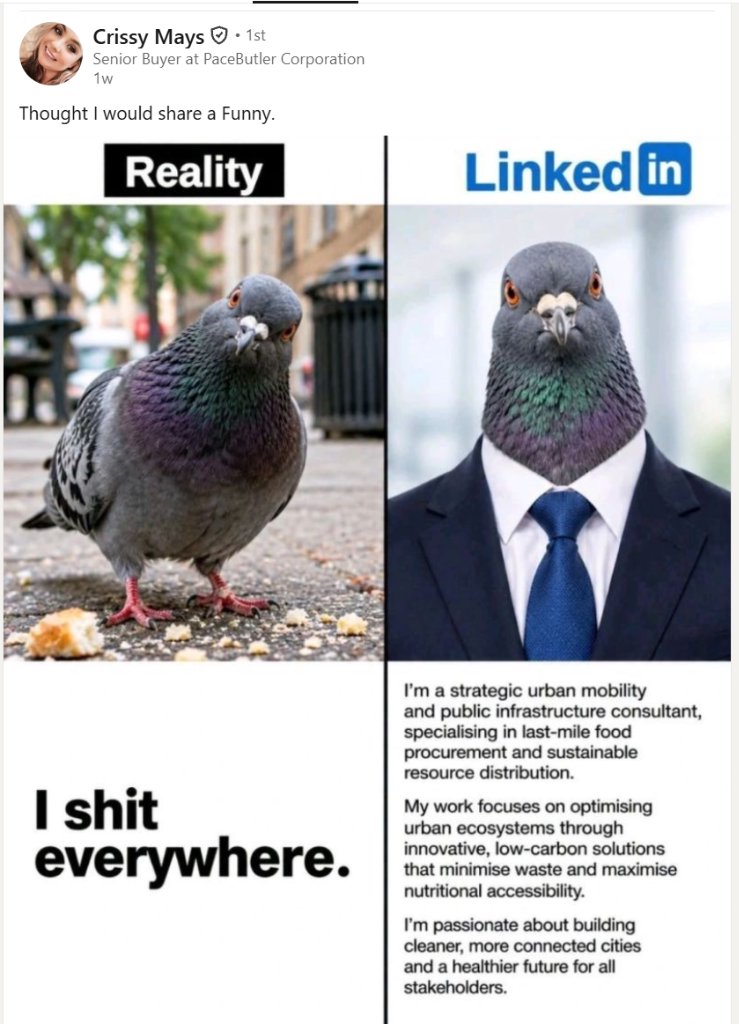
I think the funniest part of that LinkedIn post is also its most disturbing lesson.
Nothing about the bird actually changed.
It didn't acquire a new skill.
It didn't develop a new ability.
It didn't become more productive.
It didn't solve a new problem.
It simply received a more impressive description.
And suddenly, it looked important.
That is the absurdity of modern professional branding.
We sometimes spend more effort making ourselves appear valuable than actually becoming valuable.
More time polishing our biographies than improving our abilities.
More energy announcing projects than completing them.
More effort designing success than building something that deserves to be called successful.
And perhaps the saddest part is that we've become so accustomed to this performance that plain honesty now sounds almost unprofessional.
But I don't want to confuse visibility with value.
I don't want to mistake eloquence for intelligence.
I don't want to confuse credentials with competence.
And I certainly don't want to become someone whose professional biography is more impressive than the work behind it.
Because eventually, somebody is going to look beyond the polished profile.
Somebody will ask for evidence.
Somebody will want to see what you've actually accomplished.
And at that point, all your strategic positioning, transformative frameworks and stakeholder-centric professional narratives may not help you.
So here's the uncomfortable question I'm leaving in my Crazy Journal:
Would your customers recommend you?
Would your colleagues respect your competence?
Would your projects demonstrate your abilities?
Would the things you've built continue creating value?
Or would the entire impression of your professional significance disappear with your headline?
Think about it.
Because at the end of the day, the pigeon can describe itself as an internationally recognised environmental sustainability consultant.
It can add five certifications.
It can publish motivational posts every morning.
It can even become a Top Voice.
But when it lands on your freshly washed car...
You'll be looking at bird shit.
And no amount of corporate English is going to change that.
---
Inspired by a humorous LinkedIn post shared by Crissy Mays.
The Crazy Journal — where we occasionally remove the expensive vocabulary to see what's actually underneath.